


Exploring Different Types Of Robotic Grippers In Manufacturing
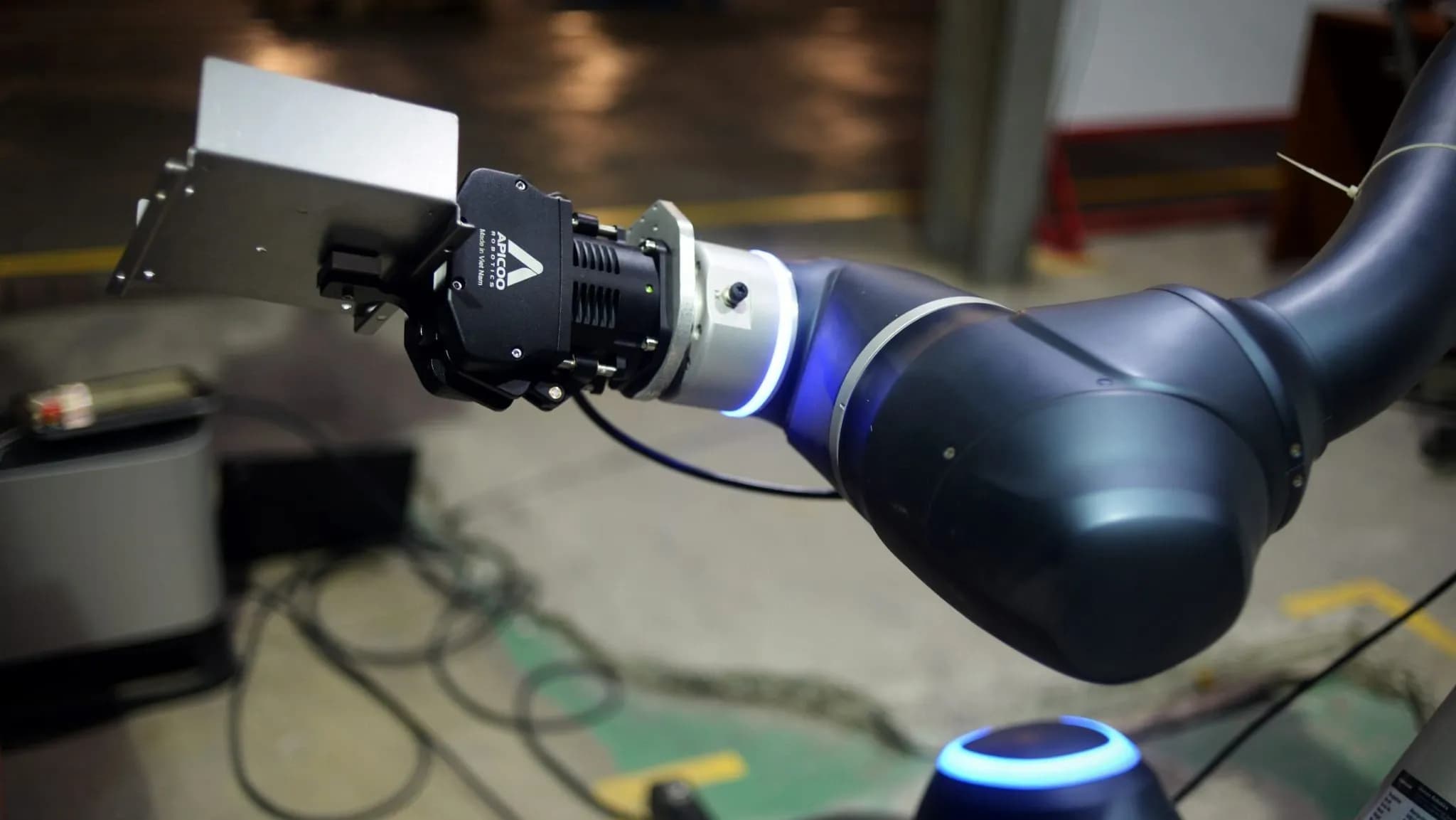
In today’s fast-paced manufacturing landscape, robots are becoming essential for addressing labor shortages, rising costs, and the demand for efficient production. At the core of any robotic automation system, the robotic gripper is recognized as a critical end-of-arm tool (EOAT) that enables precise and versatile tasks to be executed effectively.
In this article, we will explore the different types of robotic grippers and their key applications in manufacturing.
1. What is a Robotic Gripper?
A robotic gripper acts as the “hand” of a robot, enabling it to grip, hold, and manipulate objects. These tools are vital for tasks like pick-and-place, assembly, sorting, and packaging, making automation faster, smarter, and more reliable.
2. Different Types of Robotic Grippers and Their Applications
Apicoo Robotics' SusGrip Smart Gripper handling delicate electronic components
a. Electric Grippers
How they work
Electric grippers use motors to provide precise and programmable control over jaw movement, allowing for adjustable speed, force, and positioning. They are ideal for tasks that require fine control, such as delicate assembly or pick-and-place operations. Available in two- and three-jaw configurations, electric grippers offer versatility, with three-jaw models particularly suited for handling round or cylindrical objects. While less powerful than hydraulic or pneumatic grippers, they excel in applications needing precision and customizable control.

Apicoo Robotics' SusGrip-3F working in CNC machine tending environment
Advantages
- Precise, programmable force, speed, and position control - ideal for delicate or high-precision parts
- Software-adjustable parameters mean fast changeover between product variants without hardware swaps - a strong fit for HMLV/cobot cells
- No compressed air required, which means lower long-term operating cost and simpler integration
- Rich data feedback (position, force) supports quality control and traceability
Limitations
- Lower raw gripping force than pneumatic or hydraulic grippers of similar size
- Higher upfront cost than a comparable pneumatic unit
- Requires electrical/control integration - slightly more setup than plugging into an existing compressed-air line
Applications: Suitable for assembly, electronics, and high-precision tasks.
Note: Within the electric gripper category, smart grippers extend these capabilities with integrated sensors and programmable parameters - making them particularly suited for applications where part variety is high.
b. Vacuum Grippers
How they work
Use suction to lift, hold, and manipulate items by creating a pressure difference between the gripper and the object’s surface. This vacuum is generated by either a miniature electromechanical pump or a compressed air-driven pump. Compressed air-driven grippers are up to ten times more powerful than electromechanical ones, making them suitable for heavy lifting. Electromechanical grippers, on the other hand, excel in tasks requiring greater mobility. Vacuum grippers are ideal for delicate or flat objects, as the suction can be finely controlled to avoid damage.

A vacuum gripper for packing (Source: The Robot Report)
Avantages
- Gentle on delicate or flat surfaces - minimal risk of surface damage
- A single suction cup adapts to varied shapes without mechanical refixturing - useful for mixed-SKU packaging lines
- Lightweight, simple mechanism (electromechanical pump option) suits cobot arms well
- Fast cycle times for high-throughput pick-and-place
Limitations
- Requires an airtight seal - struggles with porous, rough, or perforated surfaces
- Compressed-air-driven units add air supply cost and complexity
- Less reliable for irregular or very heavy objects without a specialized cup design
Applications: Widely used in logistics, packaging, and food handling.
c. Pneumatic Grippers
How they work
Use compressed air and pistons to operate its 'jaws' (also known as 'fingers'). Most commonly found in 2-finger and 3-finger configurations, pneumatic grippers are versatile tools that can be used in a wide range of applications.

Pneumatic gripper in CNC machine tending environment
Advantages
- High force-to-size ratio at a low price point (typically USD 200–800)
- Simple mechanism with no motors - well-built units can run tens of millions of cycles with minimal maintenance
- Fast actuation, well suited to high-speed pick-and-place
- Leverages compressed-air infrastructure most factories already have
Limitations
- Force control is less precise than electric - hard to fine-tune very light or delicate grips
- Requires a compressed-air supply, adding cost/complexity where one doesn't already exist, plus a risk of air-line leaks
- Force is set per pressure/valve configuration rather than a software parameter, so adapting to a new part typically means manual adjustment — slower changeover than electric for HMLV lines
Applications: Popular in manufacturing, automotive, and metalworking industries.
d. Hydraulic Grippers
How they work
Power by hydraulic fluids, hydraulic grippers provide more gripping power than their pneumatic counterparts. However with that power come several disadvantages, including the added complexity of handling oil, a pump, and a reservoir. Consequently, hydraulic grippers tend to be higher maintenance than other gripper types.
Advantages
- Highest raw gripping force of the four types - suited to very heavy, oversized parts
- Reliable, consistent performance under sustained heavy loads
- High maintenance: requires managing oil, a pump, and a reservoir, often needing skilled technicians
Limitations
- Highest purchase and operating cost among the four gripper types
- Risk of fluid leaks or contamination - unsuitable for cleanroom environments
- Payload and complexity mismatch with cobots - essentially never used in collaborative or HMLV cells, since reconfiguring a hydraulic system for a new job is slow and costly
Applications: Best suited for heavy-duty industrial applications like construction and shipbuilding.
Gripper Comparison at a Glance
Type | Typical Grip Force | Biggest Advantage | Biggest Trade-off | Best Fit |
|---|---|---|---|---|
Electric | 100 - 185 N (up to 5 kN for high-force servo models) | Programmable precision, fast HMLV changeover | Lower raw force, higher upfront cost | Precision assembly, electronics, HMLV/cobot cells |
Vacuum | Payload up to ~20 kg (air-driven units up to 10× stronger than electromechanical) | Gentle on delicate/flat items | Needs airtight seal, struggles on porous surfaces | Packaging, food handling, logistics |
Pneumatic | 30 N - 2,000+ N | Low cost, very high cycle life | Coarser force control, slower changeover | High-speed pick-and-place, automotive, general manufacturing |
Hydraulic | Best for >50 kg payloads | Maximum raw force | High maintenance, not cobot-compatible | Heavy-duty: construction, shipbuilding |
3. How to Choose the Right Robotic Gripper?
Several factors determine whether a robotic gripper is suitable for a given application. The main ones are the workpiece, task, gripping mechanism, operating environment, robot compatibility, production requirements, and total cost.
Part Characteristics
Consider the workpiece's size, shape, weight, material, and surface condition. These characteristics affect the gripping method, required force, and gripper dimensions. For applications involving multiple part variants, check the gripper's stroke and usable gripping range.
Application Requirements
Consider the requirements of the task, including cycle time, gripping force, repeatability, and positioning accuracy. For example, high-speed pick-and-place applications place greater emphasis on cycle time, while precision assembly requires more consistent positioning.
Gripping Method and Mechanism
The gripping method depends on the workpiece and application.
Mechanical grippers secure a workpiece through direct contact between the gripper fingers and the part. They are commonly differentiated by the motion of the fingers. Parallel grippers maintain parallel finger surfaces as they open and close, providing a consistent gripping geometry across the stroke. Angular grippers move their fingers through an arc, which can reduce the required installation space in certain applications but also changes the contact geometry as the jaws open.
Vacuum grippers hold a workpiece through a pressure differential. They are commonly used for flat or delicate parts, but their performance depends on factors such as surface porosity, roughness, leakage, and available contact area.
Environment and Space
Check the conditions in which the gripper will operate, including oil, coolant, dust, moisture, temperature, and cleanroom requirements. The gripper's IP rating and material selection should match these conditions.
The available space around the workpiece, fixtures, and robot also affects gripper selection. Check the gripper's overall dimensions and finger movement to ensure sufficient clearance during operation.
Robot Compatibility and Payload
Check the mounting interface, robot payload, power requirements, and communication method. The gripper must also provide sufficient holding force for the workpiece under the required acceleration and orientation.
For the robot, consider the combined weight of the gripper and workpiece. For the gripper, consider whether its gripping force and contact geometry are sufficient for the specific part.
Production Flexibility
For high-mix, low-volume (HMLV) production, consider how the gripper handles different part variants. Programmable grippers can store different gripping positions, forces, and speeds, allowing the same gripper to be configured for multiple products without changing the hardware.
Stroke, gripping range, force control, and position repeatability are relevant when evaluating this flexibility.
Cost and Additional Requirements
The purchase price is only one part of the total cost. Consider maintenance, downtime, compressed-air consumption, integration effort, and changeover time when comparing different gripper technologies. Also check application-specific requirements such as force or position sensing, IP rating, cleanroom compatibility, food-contact materials, and required certifications.
The final selection should be based on the combination of part characteristics, application requirements, environmental conditions, robot compatibility, and production needs.
4. Why Choose SusGrip Smart Grippers?
SusGrip is integrated with Universal Robot via URCap
Apicoo Robotics developed the SusGrip-2F and SusGrip-3F to solve common automation challenges that:
- Reduce end-of-arm tool costs by 20-50%
- Plug-and-play compatibility with Universal Robot and most cobots.
- Adaptable for all workers with minimal training time:
- Parallel Motion: No height adjustments needed
- Absolute Encoder: Instant startup without recalibration
- Multi-Control Modes: From GPIO simplicity to RTU-Modbus for advanced control
- Intuitive GUI: Simple, user-friendly graphical interface
For HMLV manufacturers specifically, the combination of instant startup (no recalibration between jobs) and software-adjustable force/stroke means a single SusGrip unit can cover multiple part families without a hardware change..
At Apicoo Robotics, we’re committed to simplifying automation for businesses of all sizes.
Ready to transform your manufacturing process? Contact us to schedule a demo.